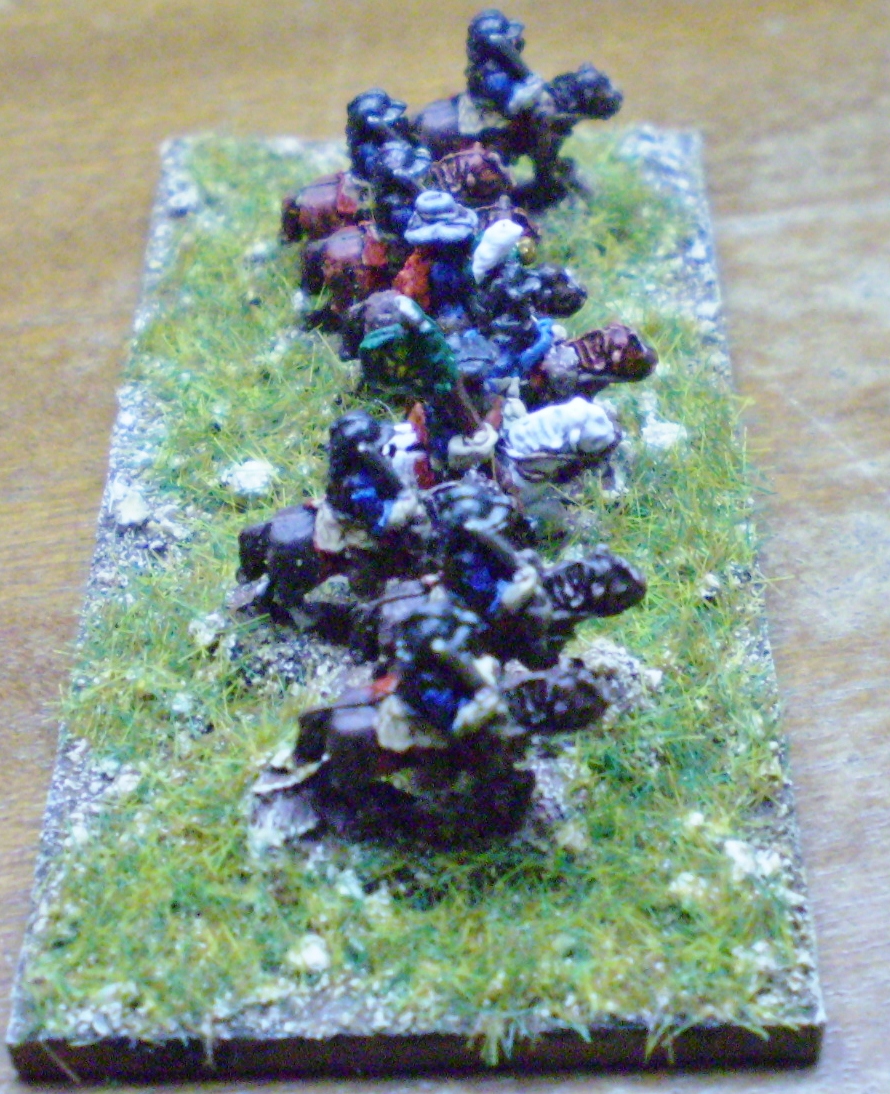
Saka Light Cavalry

Saka Light Cavalry
Showing posts with label 6mm ECW. Show all posts

Wednesday, 11 January 2017

6mm ECW Infantry, Painting Both Sides

Back to 6mm and my own painting, though not all my figures. Baccus will be releasing a much expanded and by the looks excellent new ECW and TYW range. Shame then both Lee and me have four starter armies between us! Indeed we have rather too many for the real thing but that is not going to stop us. Flags are also from Baccus, all told from three flag sheets, hopefully they will bring out more ECW ones. They will be doing some for the TYW.

I am very slowly building up both armies so getting another eight regiments of infantry off the table is a big plus. I intend to use this years challenge to get to a point where we can get a few games under our belts. Only issue is that I am not that far into writing a set of rules for this. I really want to use rules that capture the feel of the ECW so it's not something I want to rush.

Parliaments four regiments. I am building a mix of Essex's armies that fought at Edgehill and the Newbury campaign. This will allow us to play games set between 1642-44 and sets me up nicely then to paint up the New Model Army and the Kings Naseby army. Well that's the plan, much time will pass before that comes to pass but for now I am happy with recent progress.

The London Trained Bands played a big part of Essex's and Wallers early campaigns but their use was tempered by their lack of enthusiasm for long term use or their use far from home. A problem the King could relate to with some of his forces. Here we have the red regiment.

The other three regiments were all part of Colonel James Holbournes Brigade at Newbury. Col. George Langham's regiment had a blue standard with yellow tapers. I had to paint the white tapers of this flag yellow (tapers being the wavy lines designating the company number streaming from the George). The green coats are pure conjecture.

Col James Holbourne's own regiment are believed to have had red coats and yellow standards. I purposely chose a different red to the Trained Bands to add more variety. Some of the red regiments will of course be used as a base for the NMA, why do twice the work?

Col. Francis Thompson's are lacking in any detail I could find but I had to paint them up as this is my Grandfathers name! I chose blue coats and a white standard simply as they went together. In fairness it's pointless to get too hung up on uniform colours and standards as most sources fail to supply detail or it's contradicted from one source to the next. Add the fact that uniform coats were supplied in different colours at different points in time and often supply was none existent forcing troops to source their own meaning many a regiment had a real mix of colours towards the end of a campaign.

So those sad sacks are now part of Lee's army, all wrapped up with their mates. Meanwhile the King has yet to put his troops in quarters, too busy trying to get a submission ready for Friday I guess ;-)

Lord Percy brought his regiment down from the north to join the Kings Oxford army. The regiment is said to have had white coats as a fair few of the northern regiments were clothed in such manner. The blue standard is even more of a shrug at history but again I liked the look. It is assumed that the regiment was at Cropredy Bridge but certainly was part of the Oxford army a short time after.

To speed up the painting I painted a regiment of Royalists in blue coats allowing me to paint two up at the same time, these are Lord Loughborough's regiment and was raised in the West Midlands and joined the Oxford army around the same time as Percy's.

Lord Inchiquin brought his regiment over from Ireland. It was not Irish, rather it was a English regiment but it's very likely to have had a fair few troops who were Irish as it would have tried to replace it's loses by any means. It first fought as part of Hoptons army in the south west before joining the Kings army. Again it's thought it was part of the Cropredy campaign. The red standard is a guess. Often coat colours and standard colours are linked but this is not born out with a great deal of evidence. I am happy to have a few the same colour but do not use it as a rule.
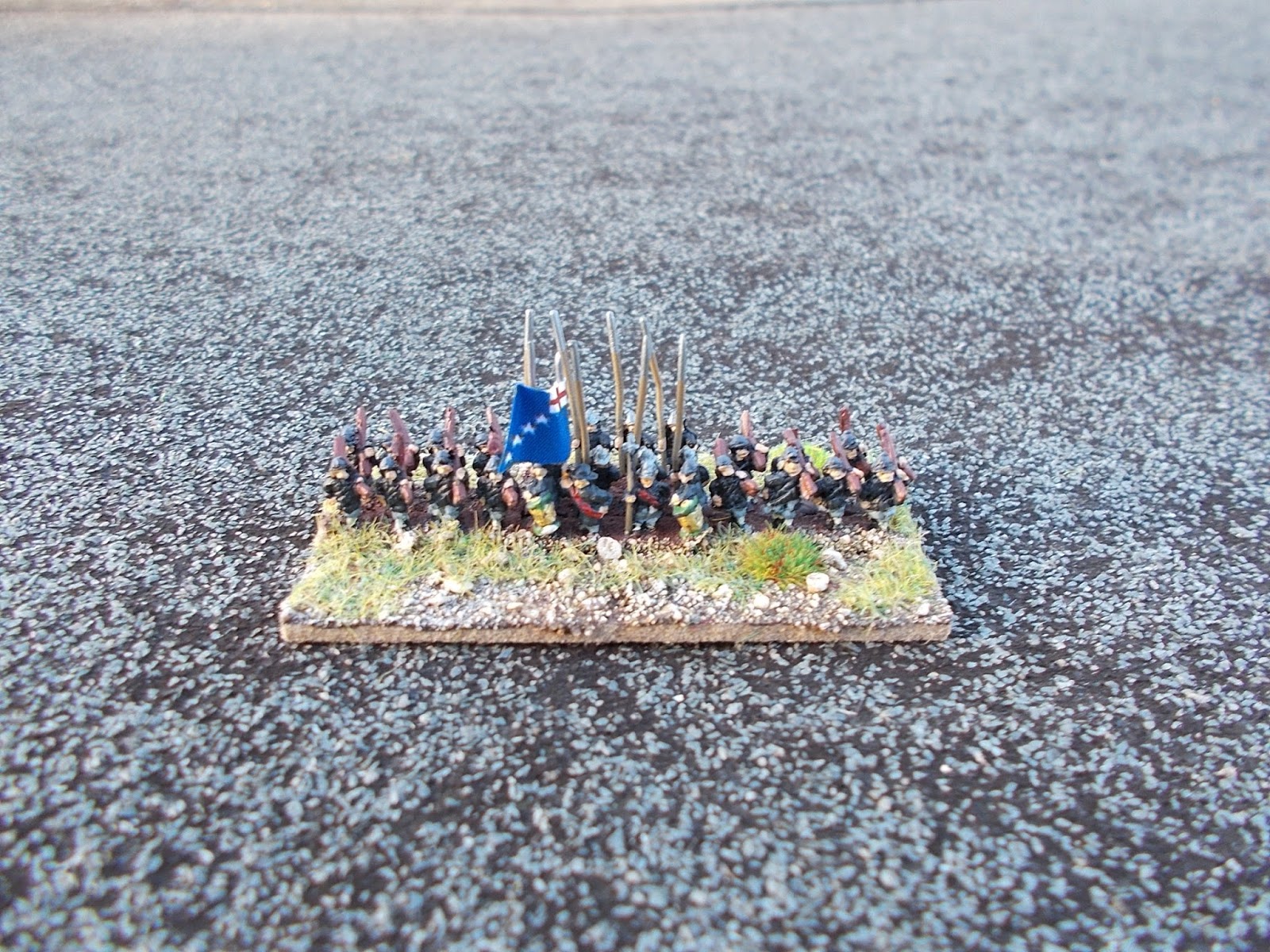
Sir John Blackwells regiment was part of the Oxford army and believed to have worn black coats but I am quite sceptical as black coats must have both been rather expensive and probably grey within a few months hard campaigning. However I like the look so went for it. Standard, well your guess is as good as mine.

Painting has slowed down quite a bit this last week as I have found flying is not my strong point and I now know EXACTLY how many steps we have on our stairs. Painting, blogging standing and sleeping have all proved to be rather difficult since. But nothing broken so I should be grateful. Now I am suitably loaded with painkillers so it's off to bed for a night of tossing and turning.


Friday, 1 July 2016

Leven Farm Tile - The Buildings

Oh it's been a long time since I last painted any buildings but I have been working on this project in the background for some time. As many will know I do like to produce building groups on tiles with farms being quite popular. 

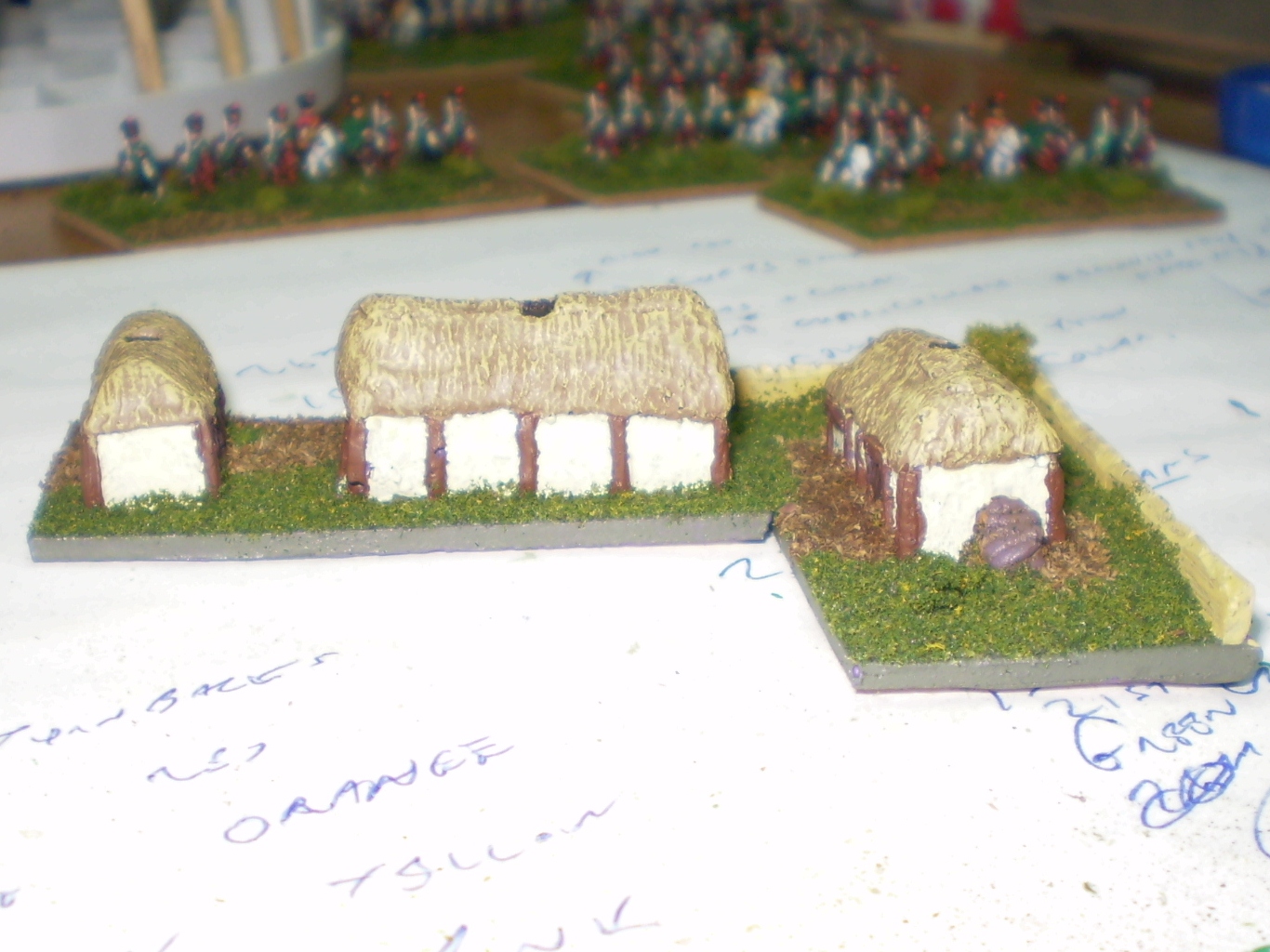
So no surprises then that these three buildings will be made into a 17th Century farm which will be used for our ECW games but also for the Napoleonic games. The buildings are from the excellent and ever growing ranges of Leven Miniatures these all from the Medieval range and quite suitable for later periods.

This one will be on a tile 240x120mm and is based on an idea I have had running through the old noggin for a few months now. I hope to get it finished in the next week or maybe two depending on the amount of hobby time I can allow myself.

Wednesday saw me with rather more than expected when I woke up about 1.30am having forgot my night time meds (despite my reminder alarm!) not able to stay in bed and too late to take them I set too at 2am and painted till Cath got up at 7. The result was three 26 figure Persian Levy units painted and just needing basing plus some work on the buildings above. Good job I have Wednesdays off work and I even had time to do other hobby stuff but by 10.30pm I was more than ready to call it a day. 

Tuesday, 12 April 2016

Parliaments Horse by Baccus

Still slowly filling in the posts for the last entries into this years Analogue Painting Challenge. The penultimate offering is two regiments of Cavalry for Essex, well Lee but you know what I mean.

I was hoping to get more units for both Lee and myself for our ECW armies but in the end I was rather more focused on other projects. I still have quite a bit of Lee's figures sitting waiting but other projects are more interesting for both of us at the moment but I will keep them in mind so I can add a few every now and again. Especially as we almost have enough units painted to sort out a game.

The Earl of Essex had a Lifeguard of cavalry to go with his regiment of Foote, well he was loaded after all. Again the uniform was tawny orange which makes them nice and bright. The only detail I know of the ensign is that it is red with a white scroll so I went nice and simple.

The second regiment, Colonel John Dalbier's Regiment is far more lost in detail. I have gone with a red coat simply as it will stand out well and also a red flag. What I do know is that Dalbier was locked in The Tower and was given his freedom on condition of raising a regiment for Parliament which he did. His regiment of cavalry was quite large and fought at Edgehill. The regiment disappears from Essex's listed regiments probably on the replacing of Dalbier as the commanding officer when he fell out of favour around a year or two into the war.

The figures are all Baccus and were nice and clean castings with the lobster pot being of exceptional detail with the face bars. I have plenty of other regiments I can paint up from the army at Edgehill so will not fall short of units to paint.

Unfortunately I did not take many pics of the units before handing them over to Lee so I can't give you much to look at. Next lot I will do better.


Tuesday, 9 June 2015

Sir Henry Bards and Sir John Boyes Regiments of Foote

Whilst painting up Lee's foot regiments I also painted up a couple of my own for my Oxford army, all figures are Baccus. The first being Sir Henry Bards who were originally a northern regiment under the command of Colonel Thomas Pinchbeck. The regiment was large enough that half the regiment was detached became Lord Percy's regiment after it arrived in Oxford in 1643. Pinchbeck was then killed at First Newbury at which point the regiment was given to Sir Henry Bard. 

The first engagement for the renamed regiment was Cheriton Woods which was a disaster and a week later it numbered but 176 mem. It has to be assumed that fresh recruitment was done in the south as it featured in the battle of Cropredy Bridge, the Lostwithiel campaign and again at the 2nd Battle of Newbury.

Losses again forced further recruitment and the melding of the Queens Lifeguard into the ranks but it obviously was still under strength as it formed the garrison of Campden House. Also you can only contemplate the morale and make up of the regiment that had started as a northern regiment and had spent so long away from home and had a large percentage of southern troops added to it's strength. 

Whilst on garrison duty the regiment was issued firelocks and it's possible it became musket only though that is not known. Originally dressed in grey coats it has been recorded as wearing red coats though it's also possible it wore both at the same time as the Queens Lifeguard wore red and in the later years supply became a greater problem and replacement coats would have been low on the list of priorities if their red coats were still serviceable.

Like many other Royalist foot regiments it was destroyed at Naseby where it's thought all it's standards were captured.

Sir John Boyes Regiment of foot was raised in time to fight at the battle of Edgehill and was brought to Oxford and became part of the standing army. They were unusual in that they wore black coats which only a few regiments on either side wore. It's doubtful they remained so clad beyond mid to late 1643 and a mix of coats fading in colour, being replaced with easier to source grey or red coats and even the mixed colours of replacement troops recruited from the area having to wear their own coats whatever the colour.

We now have enough infantry for a minor battle, though Lee still needs some cavalry and guns at the least and a few dragoons would not kill him. Next up then will be said guns and cavalry with a few command bases just to keep things sweet.

Friday, 22 May 2015

Four Regiments of Foote for Essex

Well for Lee actually but I am building up Essex's army so it's all good. This will double his infantry force so I will be moving onto his cavalry, artillery and command when I do the next lot. All figures are Baccus.

Coat red, standard conjecture. 
Lord Robartes Regiment of Foote.
Lord John Robartes was a Cornish Member of Parliament and was one of the few gentry to take up arms against the King as most of Cornwall was to be held for the King. They fought at Edgehill numbering around 500 men and survived as a Regiment until absorbed into the New Model Army in 1644. Today it exists as a Regiment of the Sealed Knot. Frustratingly the re-enactors web page which bangs on about wanting to educate us also informs that 

Edgehill marks the start of a journey that would see them fight in many major engagements across the country until being absorbed into Parliament’s New Model Army under Oliver Cromwell on its formation in 1644.

If your going to make such an elementary mistake your bound to do more harm than good. For God's sake it's Sir Thomas Fairfax you idiots! Sorry it really gets my blood up when the basics are not got right, and yes Sealed Knot that is why the English Civil War Society continues to look down it's nose at you.

Coat Tawny (orange) standard conjecture.
Charles Essex Regiment of Foote.
The regiment was actually raised in June 1642 for service in Ireland but was absorbed into Parliaments army commanded by Robert Devereux, 3rd Earl of Essex. Again the regiment took part in the battle of Edgehill it's Colonel being the commander of the left hand brigade so was probably commanded by Lt-Colonel Adam Cunningham on the day. The only other action I could find of it was as part of the force facing the King at Turnham Green the battle that never was and could have ended the Civil War in it's first year.

Of the four regiments I painted just this one with back and breast.
It is possible that the regiment took high losses at Edgehill or more likely suffered from desertion pre and post Edgehill as it is possible that many of the rank and file was OK with service in Ireland but not fighting the King. I think it's probable that it would have been melded with one of the other Tawny coated regiments very probably the Earl of Essex as his regiment would not be allowed to shrink to nothing. As to when, or indeed if I am not able to guess.

Coat blue, standard conjecture.
Sir William Constables Regiment of Foote.
Issued with blue coats on forming they annoyingly replaced them the following year with new ones, probably red or grey. Much of Essex's army did this so I decided just to stick with the Edgehill coats. As per the other three regiments the colour of the standards were not known. Overall I am picking standards that I think will look nice with the unit. Only the odd colour will be the same as the coat colour.

The regiment was at Edgehill and Turnham Green and had quite an active war taking part in the Siege of Reading, campaigning in the North then back south for the relief of Gloucester which lead to the First Battle of Newbury all in 1643.

1644, between 1st of March and 18th April they are supposed to have served as Dragoons, if this is so then it's probable that by this point the regiment was much reduced in size. During it's Dragoon role it was involved in the battle of Cheriton and was reduced less than a month later. 

It's a safe bet that whilst in the North it would have had a steady loss of troops through battle, disease and desertion. Being away from it's home area it would have been even more difficult to replace the loss. 

Blue coats, standard conjecture.
Sir Henry Cholmly Regiment of Foote.
I can find less detail regarding this regiment. It was possibly originally part of the London Trained Bands under the command of Cholmly's brother Hugh with Henry as the Lt-Colonel but through the disruption caused by the ship money tax Hugh fell foul of Strafford and was removed from command though he was offered it back later but refused, requesting instead it would be commanded by his brother.

It's also possible that it was either a separate regiment or was partially recruited from within the Trained Bands. Either way it's safe to assume that Henry has had some level of military command and had been involved in the Bishop Wars so was aware of the difficulty of campaigning.

The only battle I have been able to track down was Edgehill and again part of Charles Essex Brigade.

So Lee now has eight foot regiments putting him a little ahead of me, though I have cavalry, artillery and dragoons painted up. I did find it difficult going painting up these units as I also had a load of other bits on the go as well, though I did sneak in a couple of mine, more on those later.


Saturday, 4 April 2015

The Start of Something Essex

Last figures from this years Challenge to be added to the blog and four Regiments for Lee's ECW army I am painting for him. We decided the best army to paint up would be Earl of Essex as we know a fair bit about it and as I have started Charles Oxford Army they are a natural opponent for them.

All the figures for both Lee's armies and mine are Baccus, we both have two army packs so no shortage of units between us.

I have started with some of the better known regiments, though I will work through a list that will quickly exhaust these.

I had to start with The Earl of Essex, I mean who else could I choose? I went for a reasonably solid orange for the Tawny Orange whilst the standard is not actually known from what I can make out. Baccus will be replacing the current figures in the future and expanding the range to include the Thirty Years War so we will have even more options at some point in the future. Both Lee and myself have a mix of very old castings and an army each bought about three years ago. 

Lord Saye & Sele's blue coated Regiment comes up next and again the actual colours are not known. I have gone with a blue flag as I felt it looked good. Never assume the flag would be the same colour as the coat or nick name as this was not always the case. Early research favoured such a view and using the colours of ECW re-enactment regiments can and often is misleading. 

Thomas Ballard's regiment was dressed in grey, at least during 1642. As the war went on coat colours were sometimes changed or through poor supply ended up in a mix of colours. Trousers were even worse as these tended to wear out first and often were not officially replaced so would best be depicted in a mix of colours but in this case all four Regiments have single colours for their trews, though not every Regiment has the same colour.

Lord Brooks is the last of the three and I picked this one as they wore a rather striking purple coat. This is also the only one of the four painted that I have the correct flag for. All flags by the way are from Baccus, I am making use of three flag sheets across the two armies. Oxford for me, Essex for Lee and a generic one for both of us. 

Unlike the Napoleonic's infantry are based on the same 30x60 bases as this suits the formations used during the ECW. We have yet to decide on rules and it's possible we will do our own set though I am keen to try a few other sets out as well. ECW was the first period I wargamed and I still have my 15mm which I would love to use again but 6mm will give us the opportunity to fight some of the biggest battles and possibly nip over the Channel for a bash or even make up a campaign that would allow us to field large and small armies that take into account all the possibilities of the period.

Saturday, 21 September 2013

Building(S) of the Week - Medieval House A-B Leven Miniatures

Been quite a dry month for painting so far with not a lot finished and far less time spent at my desk. Managed four hours this morning though so hope to show some more figures here during the coming week.


Anyway on with the buildings, started them on Tuesday with a total of three sessions in total spent on these two and a third I will be posting about later in the week. Here we have two of the buildings I recently had delivered from Leven Miniatures. They are part of the Medieval/Saxon range and I figured they would look OK as part of my town, the old part of the town to be exact. 


These will also be great for the future ECW battles we will be having once we have enough troops painted up (how often do you have all the buildings painted up before the figures?). These two are MED04 and MED03 and cost £2.50 each and are the usual Leven standard. I wanted to go for old looking and got the effect on the left hand one with inks whilst MED03 had chestnut brown ink added to the woodwork rather untidily and then the top coat (Vallejo German Camouflage Beige) painted over the recess area's just a little thin which gives a bit of a mottled finish.

To help with the generally run down and unplanned look I staggered the buildings. I really want another four or six of these or similar that I plan to add to a few bases either in rows or in a winding fashion. I'm really pleased with the end result and think I can do them different enough to keep them looking none regular.

I plan to change a couple such as removing the chimney or removing the brick pattern on them. I may also add a lean too or such to one or more to show that it's been changed since being built. I also went with wooden tiles for the roofs, after all we all like a good fire when we wargame!

Some of the tiles on the closest building have been replaced (more on the other side) so they are not totally forgot about. If you look close you will see the roof is just that but bowed and some of the rows of tiles have slightly bigger tiles in parts or are not evenly placed with the odd row being set further back. Nothing that sticks out a great deal but adds to the ramshackle effect.


The ink used on the roof was Vallejo flesh tone and the walls were treated to Sepia from the same range. The HMG matt varnish took just the right amount of sheen off the models, that is to say it matted them right down! Still love that varnish though it takes an age to dry.

I'm wondering if I can get three maybe four of these on a 60mm square base. That would be some serious real estate for Broke Row. At £2.50 you can get through a fair bit of dosh if you want to do crowded over a larger area but it will look great. Also cost is relative, if you compare with the other market leaders it would be a chunk more. 

Next week I will do an update showing the town with all the buildings I have finished and based laid out. I still have a fair few to base and oh so many more waiting to be painted. I think I could go to Derby next weekend, spend not a penny and still have a couple of years worth of stuff to paint. Not that I am planning on spending much, but I am so looking forward to the show though.

Friday, 3 May 2013

Duke of York's regiment of Foote


Another Regiment of the Oxford Army was that of the Duke of York (Charles eldest Son James) though being only nine at the outbreak of the Civil Wars he was just a figurehead and never commanded the regiment. In fact the Regiment did not start life as a Royalist Regiment but was raised by Parliament and sent to Ireland to quell the revolts there. Somewhat ironic then that it would be shipped back to England to fight against the Parliament that raised it. Not ironic however was Parliaments propaganda that insisted that these were Irish Regiments, that is native Irish. Many of these men had taken Irish women as wives or simply camp followers who were Irish. Many of the fighting men of the regiments that had been called Irish were refused quarter as were the women camp followers. Many English and Welsh were killed under the suspicion of being Irish including such as Cornish troops who's accent was so far removed from normal English that all to often they were killed by mistake. Indeed not a small amount of real Irish troops killed were in fact Protestant and not the feared and loathed Catholic. 

The Regiment was raised in 1642 but was returned to England in 1643 via Bristol. Later it would have been brought south and incorporated into the Oxford Army where I suspect it was fleshed out with new recruits and as the regiment is known to have had red jackets had been re-clothed whilst in Oxford. Also stated is that the Regiment wore grey trousers though I suspect this would not have been throughout the whole regiment as replacing a whole regiment from head to foot would have been very costly and they would have required replacement footwear at least once since returning to England.

Originally the regiment was in Prince Maurice's force fighting in Herefordshire but on joining the King's army the regiment was given the name Duke of York's Foote though Lt. Col. William St Leger retained full control of the regiment. The regiment was thought to have been at Cropredy Bridge (which is why I painted them) as well as the Lostwithiel campaign. It was also at second Newbury where St Leger was killed and probably replaced as commander by Theodore Kyrton who's impressively named brother Posthumous had been killed at Marston Moor leading a Regiment of Whitecoats. 

In 1645 the regiment was part of the force that stormed Leicester where the regiment did well enough to capture Ireton and beating off his regiment before finally being overwhelmed and if not destroyed certainly reduced to a shadow of itself. It certainly did not survive the aftermath of the battle. So a colourful regiment that saw long and active service.

I have painted up the regiment both in 6mm and 15mm, today I will show off the 6mm and tomorrow will be the turn of the 15mm boys (allowing Matt to ignore the post if he wants to see them in the flesh first).

Only one decent shot of the brave lads, figures and flag by Baccus though the flag was not lined up well on printing so lots of white between the black and red sections so I ended up repainting most of it so you can't see where the original colour runs into my clean up. I always paint the edges anyway to get rid of the white edges and get well rewarded with a crisper finish. 

My ECW force is steadily growing and once I have all Matt's figures painted (yes the Zulu's) I will be starting work on the Army of Essex for Lee which I am rather looking forward to. This should mean that before the end of the year we will be seeing our first ECW battle in 6mm. I plan to rework my Napoleonic rules (actually only a form of the combat tables will be used) and write a pure ECW set of rules that should bring the special flavour of the period across. The ECW really suffers (like the ACW) from too few troop types and if you use normal rules can get boring quickly. Rules that give a feel of the ECW I hope will have longer legs. But that my friends is another day.

Wednesday, 10 April 2013

Baccus ECW Guns


I am really getting back into the English Civil War, not just the wargame side but the social history and beyond. I'm not exactly short of material to read, given the size of my 17th Century collection. So the fact that Peter at Baccus is a ECW buff is more than just a bonus. He bravely insisted that the infantry were not sculptured wearing soft brimmed hats as the felt hat as we know it did not make it into England in any kind of numbers till after the Civil wars and whose that were in the country were expensive and just worn by the rich. So all ranges are at fault. I do believe some sort of brimmed hat was available due to the evidence of wood cuts and the like but felt hats they were not. Most troops would have worn what these days are called benny hats or some form of the Spanish peaked mountain cap or Monterio as it was known at the time. Personally I think the benny hat would have massively outnumbered the Monterio due to the  amount of work that would go into the production of a Monterio and as such the greater cost.

Anyway I digress, here we have two field pieces for my 6mm ECW Oxford army. The crew for the most part are dressed in civilian clothing as all but the master gunner would be only one stage removed from drovers and camp attendants. 

As you can see the only splash of colour is the gun crews officer. I painted them up in blue or red as this is for my Oxford army. I do have another six guns which is probably as many as I will ever need as I don't want to have a grand battery or such. In fact under the rules I am toying with these things will never be ones for killing men as much as effecting morale. The quality of gunpowder and understanding of ballistics at this time was much removed from that of the Napoleonic period though growth in understanding was rapid post the civil war period. 


It's a good job I have the bug mind as I have a few regiments to paint and in a few scales. First the 6mm stuff to the tune of two army packs which I am working my way through. I am also going to be doing Lee's 6mm, that's another two Baccus army packs, of yes seriously. It makes the three regiments of 15mm for Matt look a drop in the ocean, which it is, especially as I am half way through the first regiment but then again I still have one of my own to paint and will buy more 15mm of my own to grow and replace some of my 15mm I already have. Not satisfied? how about another scale then. I have agreed to also paint up some 10mm ECW which I am sure Lee will be happy to hear (NOT) given I said I wanted to go down the 6mm route as 10mm would be as much bother as 15mm. Seems like I will find out if I am right.

So can my poor followers just expect a long series of posts on ECW and 6mm Napoleonic's? Er no don't worry, all other projects will continue to be brought before you. I really want to get some of the other 15mm Ancients finished and those Romans won't paint themselves and I have a three figure diorama I am itching to get to grips with. Unfortunately painting time is now reduced but what you will get is diversity.

One last point, the giveaway for the new Baccus French Napoleonic figures has another five days to go so if you want a chance to get a whopping 25% off you better get to the previous post and get your name down.

Saturday, 23 March 2013

Sir Thomas Aston's Regiment of Horse

Born 29th September 1600 in Shropshire died 24th March 1645 from a fever complicated by a head wound  gained whilst trying to escape captivity in Stafford. Sat in the Commons in the Short Parliament.

Sir Thomas Aston was active from the beginning of the 1st Civil War recruiting his regiment of horse from September 1642 by the time of the battle of Edgehill (23rd Oct 1642) it numbered at least three troops (number involved in the battle). 1643 saw a number of known actions the biggest being 1st Newbury 20th September 1643. But prior to this he was in command at two minor battles Middlewhich 13th March losing to Waller who also captured two cannon. The other battle was near Macclesfield this time against Brerton  and it's possible this was in late December but the information is confused as a Colonel Ashton was involved at this battle and was fighting for Parliament. What ever the date and actual location this was another defeat for Aston (unlike the battle involving Ashton).

Aston was captured in a skirmish in Staffordshire (date and even YEAR unknown) I suspect 1644 as by 1645 the north was already lost to the King with most of the action being in the South. This is also backed up by the fact that his regiment of horse was active at the 1st Battle of Newbury as mentioned above. I doubt it would have been sent back north given the Kings need of experienced cavalry at that point. He tried to escape from prison in Stafford but a soldier caught him and struck him on the head bringing n the fever. It seems he must have been a brave man as from the information given he was already weakened from several wounds from previous combat.


His regiment can be used in battles in the North up to mid 1643  but post then should be part of the Oxford Army and it's quite likely it was part of the Cropredy campaign but being away from it's recruiting ground it's likely that it's strength would be diminished unless it was strengthened with independent troops of horse.


These are Matt's 15mm Museum Miniatures that he will be basing for FoG:R I went with blue coats as they were at Oxford during the equipping period prior to Newbury. I used an old Revo cornet but had to free hand it on the trumpeters banner which I was pleased with the result. I quite liked the figures, mostly accurate though I would have liked a mix of headdress to reflect reality.

Here we have the same regiment but in 6mm, the cornet this time is in green, I blame it on the fact that on painting this one I had not picked out an old flag.

And from above. This now gives me two regiments of cavalry three of foot, two mounted and three dismounted dragoons and a pair of guns. Some way off what will be needed to play a game but they are coming on. I have three regiments of foote to do for Matt so I will at least get three more infantry painted up.

Thursday, 14 March 2013

Sir Robert Howard's Dragoons

Sir Robert Howard's Dragoons was never a large regiment consisting of just two troops one commanded by Captain Richard Catesby from Warwickshire and a possible relative to the Gunpowder Plotter whilst the other troop was commanded by Captain Lewknor. The only known recorded engagement for this regiment was the storming of Bristol in 1643 when they were attached to Washington's Regiment but it's a fair bet that they were also involved in the Cropredy. Most Royalist Dragoon Regiments were lacking in men and or mounts so it is not really an issue to base a regiment for the wargames table on such a small regiment as most were just as bad with some even worse!

Over the next month or so I will be painting up a number of Royalist Oxford Army Regiments and I will start here with those poor old boys the Dragoons.

Here we have the mounted 15mm figures, only four as these are for FoG:R and most of the figures will be dismounted. so four bases will have a single mounted figure to show they are indeed Dragoons. However I don't have that problem in 6mm

Here we have one of the two bases of my dismounted dragoons, I got carried away. This is not really a problem as I can change the turnbacks colour on one base and I have yet another dragoon regiment.

Here we have the 15mm dismounted boys in felt hats. Of course in reality very few felt hats were in England at the time and these were rather expensive. However I do feel that some version of brimmed hat would have been worn, possibly leather? To many contemporary images show a brimmed hat exen on some common soldiers. 

Here are the even more historically inaccurate Lobster Pot  helmets. Yes they were worn but they would not have been worn by 50% of a dragoon regiment, only by some of the officers, cornets and maybe the odd rich volunteer though these normally were in the cavalry and a few fought in the infantry. The 15mm are Museum Miniatures and are larger than the typical MM figure which in the case of the mounted is a bit of a shame as the horses are just too large for Dragoons to have a hope of keeping them. They would be mounted on nags IF they were lucky enough to get any at all.

 The flags are pure conjecture as is the green facing. Howard's Dragoons were thought to have worn red which is a good guess given they are part of the Oxford army where red and blue were the main uniform colours throughout the late campaigns.  These are also the first troops I have based up by using Lee's basing system (nothing new as many do it this way) but new to me.

Wednesday, 2 January 2013

Baccus Old Style Buildings

Remember when Lee and I bought the ECW starter set at Donnington (Derby) last year? Well it was the original starter set that came with the resin buildings rather than the new style. Peter has since sold these buildings and started to have buildings made by Timecast. Whilst the old style does not stand up to Timecast standards they do have a charm of their own. Unfortunately the person who bought the moulds has yet to produce buildings for sale and enough time has passed to suggest this will not come to pass.
 
The tile base system that Baccus uses now actually started with these buildings. These are considered ECW though they could be of a earlier date. Me I see them as a ramshackle down at heal hamlet or average farm.
 
These were fast to paint up though I added flock to the base as it looked crap without. The brown blob on the end of the building on the right is a pile of logs, these do look better in real life honest.
 
Not sure the wall really adds anything to these buildings. I suppose if other building were available then it would be a different story. Not that the walls are a big thing.
 
I know I should have used a ECW stand of figures for this shot but their box is near the bottom of the pile and I had just finished these guys.